Sunday, January 8, 2017

A Snow Day is a Good Egg Gourd Day!

A 6" snowfall is a great Window of  Opportunity!
Many new gourd enthusiasts want to know "How do I make this a little business?  I like it, and I'm prolific, but how do I move product so I can enjoy making more?"  When preparing for gift giving, or for selling, the best thing to do is take advantage of those windows of opportunity such as weekends, holiday down-time, or snow days.

Usually, an artist will work on one piece at a time, tweaking it to a place where it is precious and considered a one of a kind. However, if you are getting ready to gift a lot of people or want product to sell at a farm market or other venue, efficiency will be paramount to make you time worthwhile and still offer a unique item at an affordable price.

Previously painted egg gourds stand ready!
Once you perfect a technique, and can break it in to steps, try to do multiples of one step at a time. In that way, when a window of opportunity arises, you can dive right into a project without all the rigmarole of starting from scratch.

Just a little hint from the Crackled Apples gourd patch of the Virginia Lovers' Gourd Society - Happy Gourding in this 2017 Winter!


It may be snowy now, but Easter will come again!

Saturday, December 10, 2016

Traveling Work Station

Many gourd enthusiasts like to work on their craft with others, either at gourd patch meetings or when visiting other like-minded individuals. How to set up a convenient work space?  Gourdacious Dappled Apples gourd patch member showed up to a recent monthly project day with a handy dandy solution she whipped up for the occasion.  A portable work station!

Made of a wooden breakfast tray she got at a flea market or thrift store, she zip-tied a power strip to one side, and a clamp-on light at the other end. She took out her work station, plugged it in, and BAM! she was in business!

This was the day when we were using melted Crayon to make snowflake designs on egg gourds for ornaments. All her tools and materials stayed within reach and, as you can see, the ornament looks great!


Thursday, April 21, 2016

St. Jerome

Recently I came across a cast-off book about the history of windows. Upon opening the book, and looking at the engraved frontispiece, what do I see ? **gasp*!


What do you notice?  Yeah, ME too!  The gourd hanging in the upper right-hand corner!  In this detailed 1514 illustration by Albrecht Durer. This work is packed with symbolism, but I cannot locate any source that picks out the symbolism for the gourd.


Monday, March 7, 2016

Embroidery Rims


There are so many ways to rim the top of a gourd vase or bowl to give it a finished look: sea grass, rope, leather, leaves. Most involve tying or wrapping a material to the rim with a string or thread. In our newest exploration, we look at embroidery floss and beads. We use a whip stitch and a running stitch, catching beads between the holes as desired. All who participated achieved a favorable result, even those with NO sewing or gourd experience.

We started with a small gourd that was previously cleaned and gutted. Holes were drilled around the rim and then the sewing began. Initially, put glue on the floss before pulling the last bit through the hole. That secures it as you move around the rim. If you use up the thread, glue the last bit of thread before pulling it through the hole and begin with another thread through the same hole. There will be tails of threads hanging inside and outside, but those can be trimmed off at the end.

One tip that made a difference was using a looped flossing threader (for teeth, not an embroidery product).  This was good because the embroidery floss slips right through a tight hole and the threader worked with bead holes of all sizes.  Another product one of the members found, and brought, was a metal threader. This picture from Yarnplayer's Tatting Blog shows the differences. The metal versions can jam through tight holes easier than the plastic tooth flosser, but also experience metal fatigue after a while and break at the loop tip. Either way, it made doing small gourd bowls easier than using a regular needle that was too stiff to negotiate a small area.

a close up of the bowl to the left


this one is using seashells

Another day, another project -- it just gets better and better!
Keep those ideas Cracklin'!


Wednesday, January 27, 2016

Gourd Ukelele

I teach research skills to a bunch of gifted middle school apples. Each semester as they learn how to do college level research on a topic of their choice, I do a project too to demonstrate the lessons and strategies. Last semester I chose to research gourd musical instruments, in particular a gourd ukelele.

I started with the song, Follow the Drinking Gourd. Dr. Uke's Waiting Room has the lyrics and chords on his website. In fact, the Audio Play for the song is a terrific way to learn it....Brilliant Dr. Uke! The song's history is long and varied depending on the historian questioned. In any event, it started my personal research into gourds in combination with music.

These were the pieces I ended up using for my project: a kettle gourd, a front from a guitar, and neck from a mandolin. The final ukelele is still in the garage being assembled, but so far so good!


A kettle gourd cut in half. 
An old guitar face shaped and glued on
the gourd with a reinforcing bracket
across the belly along the front of
the face interior to keep the gourd from
changing shape over time.


Mandolins have a foreshortened neck. There are too many
thumbscrews, so two from each side was removed.

Now, as the semesters have gone by and I have come up with some gourd parodies (see previous posts Always On My Mind - 3/20/15, Gourder Ladies - 3/10/15, Wooden Heart - 2/13/15, WonderGourd - 2/10/15, and That's A Gourd, Eh? - 2/8/15), it is time to revisit the gourd ukelele! I have decided to forego the mandolin throat and use a tomato stake and thumbscrews purchased through Amazon.com. This will be more aligned to the rustic, gourdy appearance I want to maintain with this project. Unlike gourd banjos by Barry Sholder, this one will be earthy and a lot more knock-about.


Right now, the back of the gourd has been wordburned with the beginning of vines. There will be leaves covering the empty spaces, to embrace the entire surface. Once that is done, the stake can be woodburned to continue the vine/leaf concept and put into place. Then, it is just a matter of stringing it up and let 'er rip!, song-wise that is!


[week later]  The next week, the belly was burned with leaves while chattin' with the gourdheads at a patch meeting. Hours passed but look at the leaves -- it produced an overall design that is fun to touch as well as see. A chisel tip was used on a basic, Boy Scout-type burners purchased at a big box store.


Another day of exploring new ways for old ideas!  
Keep Crackin'!

Friday, January 15, 2016

An Historic Look at Doodling

Continuing on our crackling gourd time of doodling, let's have a look-see at another time when doodling was popular, and now collectible. Delft pottery is a blue on white design that originate in the city of Delft, Holland in the 1700s when potters made imitations of Chinese porcelain with earthenware fired with white glaze and painted with blue designs. Only one factory remains in Holland that makes Delft designed pottery, Royal Delft. Today the blue/white designs are still eye-catching and highly collectible.

How did we get to this area of study? One of the Crackles is a member of the Guild of American Papercutters and in preparing to do an egg project, located a wonderful Ukranian egg YouTube with Lorrie Popow. At a recent gourd patch meeting, as the group was discussing the contrast of blue and white we noticed our snack of the day was in a Delft-inspired bowl from Dollar Tree -- what a cowinkiedink!

By reviewing the YouTube, the snack bowl, and various Delft auction items on eBay, we found there are some basic lines similar to all. By repeating those lines in various combinations, and maintaining the blue lines on white background concept. The flower is built, as you see, from a center circle, by adding more and more petals. The petal tops can have different finish tips as shown. The basic long, curved line and scallops can have infinite variations. Why not apply Delft to gourds?

The first trial started as an exciting exploration until we found out using white gloss spray paint to produce the background made the surface too slick, and the Sharpies we were using would not always be clear so lines had to be re-drawn to strengthen them. Using a satin spray made that problem much better.

Once done, spraying to protect the design became a real challenge because of bleed. Krylon and Rustoleum clear acrylics made the Sharpies bleed, no matter how light the misting was applied. Using paint to do a one-stroke painting would have been far better -- if only any of us knew how to do that!  [Another skill to investigate!]

One lesson learned, and only  hindsight made this real to us, was the fact that applying spray paint to a gourd in a cold garage -- even though it dried hard -- did not keep the paint on the gourd!  When trying this at home, spray a room temperature gourd with room temperature paint. Otherwise, everything can be flaked off with even a minor fingernail scrape.

So, lessons learned and explorations complete, we have a gourd bowl with a variety of Delft-inspired designs around the belly. In the next project attempt, we would choose one design and repeat it around the bowl for a more controlled and deliberate look. As of now, it has the look of a doodle. Eventually, this bowl will have a silk ribbon rim sown onto it after the edge has been cut to mirror the edge of the design for an uneven, dynamic top.

Great exploration Crackled Apples!


Saturday, November 21, 2015

Doodling With Gourds

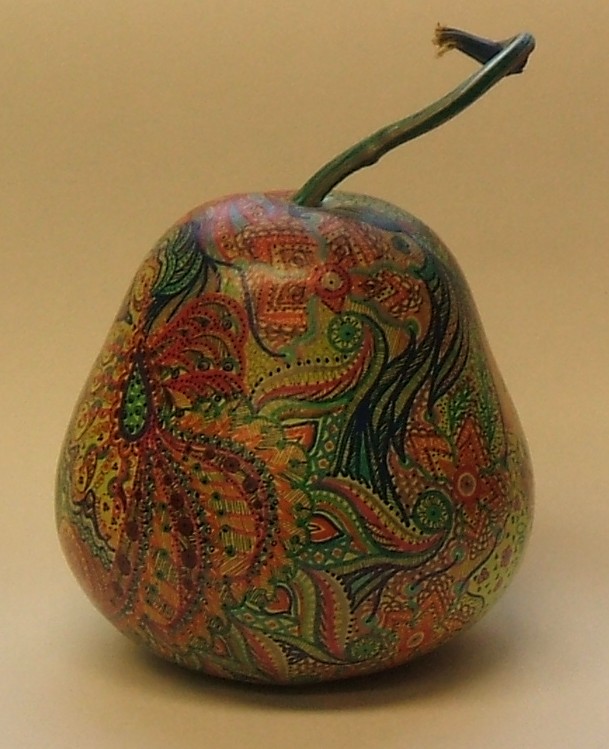
Inspired by another Crackled Apple, Glenda, we crackled gourd enthusiasts have been working with Sharpees to do relaxation and meditative exercises. Glenda, a psychologist, explained the psychological release that focusing on a repetitive, yet creative, activity could be and showed us what she had been working....egg gourds.

As you can see, they are random paisleys and rows of repetitive designs without any specific organization. However, the overall effect is just lovely!  Sprayed with several coats of of Krylon Triple Coat, and the glass-like surface make them irresistible!

It had to be tried!  Remembering the lessons we learned from an earlier post about Sharpees and the fading potential when using them on untreated gourd surfaces, a gourd was spray painted initially to give it a waterproof surface for the marker ink to rest upon (instead of absorbing into the gourd wall). In this case, it was lime green. It began with one image - the paisley you see in image one and then grew and changed around the circumference as whim and fancy directed. Once started, it was hypnotic!  She was right-this became a total tunnel vision activity that blocked out any other thoughts of the day. It WAS calming, and the result most pleasing in a carefree and random way. A few layers of Triple Coat should really glass it up!

1. The little blue paisley on the left side
is what started it all.
2. rotating to see the side


3. 

4. 

5. 

5. This is how everything came together
at the bottom....

6.  ...and how it met at the top.

Try it - you might have a Cracklin' good time!